
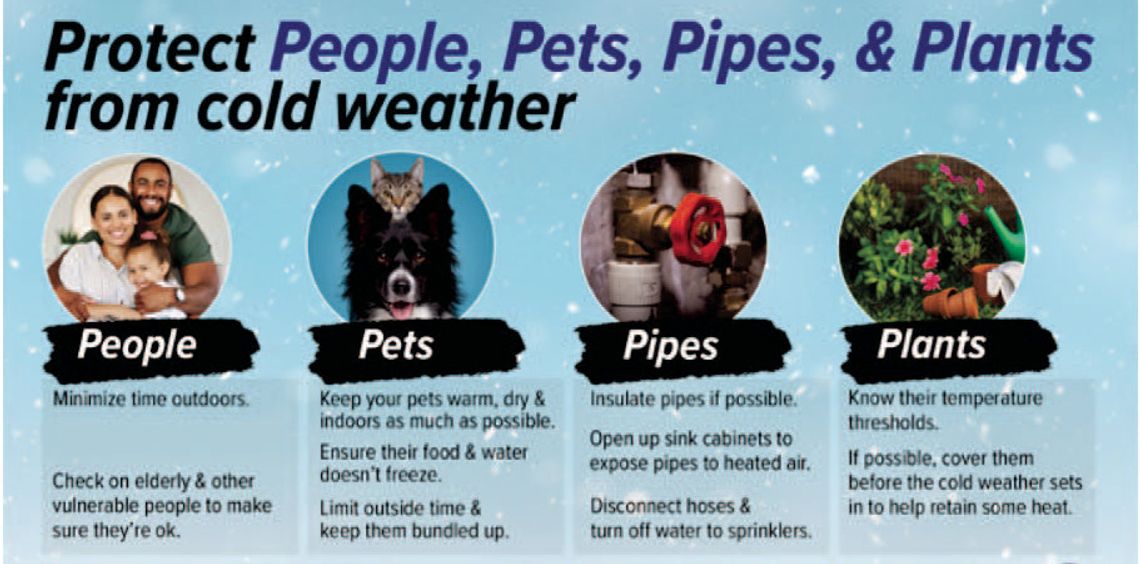
We strongly advise you to stay informed about the upcoming weather by visiting the National Weather Service website or by tuning in to your local television and radio stations.
As the winter storm approaches, I will do my best to keep you informed. However, your best source of notification is your local radio or TV station, or the National Weather Service website, which can be found at https://forecast. weather.gov/.
Below are a few of the many precautions that can help minimize these impacts on our lives and property:
Before the Freeze
Disconnect and drain hoses from outside faucets. Turn off and drain your irrigation system and make sure that your backflow devices are drained and insulated. Wrap outside faucets or install faucet insulation covers.
Insulate hot and cold-
...see Page 5 water pipes in unheated areas, such as the garage, crawl space, and attic. Locate and show everyone in your household where the main shut-off valve is for emergencies.

If you know your neighbor is away, please contact them to let them know about this severe weather event. They need to prepare their home now to prevent damage.
During the Freeze
Open cabinet doors under sinks, especially where the plumbing is on an outside wall. This allows interior heat to warm the piping and lets faucets drip slightly.
If you are away for any length of time, leave the heat on at least 55 degrees. Shut off the water to the house and open all faucets to drain the pipes. Make sure you turn off the power to your water heater to prevent the elements from burning out.
Frozen Pipes
Never thaw a frozen pipe with an open flame. It is easy to start a fire. Use hot air from a hairdryer, a closely monitored heat lamp, or an electric heater.
If your lines are frozen, assume they may be broken or split somewhere. Be ready to shut off your water quickly when the line thaws.
If your pipes break, shut off the water at the shut-off valve and make sure you turn off the circuit breaker to your water heater.
Do's and Don'ts
It takes only about a quarter to a half inch of ice buildup on power lines to cause outages. As ice builds up on power lines and trees, things can get dangerous, as both could come crashing down due to the weight of the ice. Here are a few tips:
• Keep your phone(s) and all other electronics charged;
• Always keep at least a three-day supply of nonperishable food in your home;
• Keep fresh batteries on hand for weather radios and flashlights; and
• Dress warmly. Wear multiple thin layers instead of a single thick layer.
Also, use a National Oceanic and Atmospheric Administration (NOAA) weather radio to monitor changing weather conditions. Better yet, sign up for WarnCenteral-Texas.org, which will notify you via phone, email or text of any severe weather in our area.
Keep alternative heating sources and fire extinguishers on hand. Be sure your family knows how to use them. Always practice “Fire Safety” in the National Fire Protection Association brochure on home fire safety.
Also:
• Store an emergency kit in your vehicle. Include a window scraper, jumper cables, a tow chain, sand/salt, blankets, a flashlight, and a first aid kit;
• Make an emergency supplies kit for your pet and include medical records, a first aid kit, canned/dry food and water for three to seven days, and a pet travel bag or carrier;
• Do not leave pets outside for long periods; and • Bring pets inside when temperatures drop below freezing.
Other tips include turning off or disconnect appliances and other equipment in case of a momentary power “surge” that can damage computers and other devices. Consider adding surge protectors.
In a power outage, keep refrigerator and freezer doors closed. Most food requiring refrigeration can be kept safely in a closed refrigerator for several hours. An unopened refrigerator will keep food cold for about 4 hours. A full freezer will keep the temperature cold for about 48 hours.
You are urged to stay informed in the coming days, as this winter weather event could be dangerous and lifethreatening. Tune into local radio and TV stations for the latest updates on this upcoming storm. The latest forecast from the National Weather Service can be found at https://www.weather.g ov/ewx/.