Welcome rainfall in Burnet County during recent weeks has prompted the Central Texas Groundwater Conservation District board of directors to lower local drought restrictions.
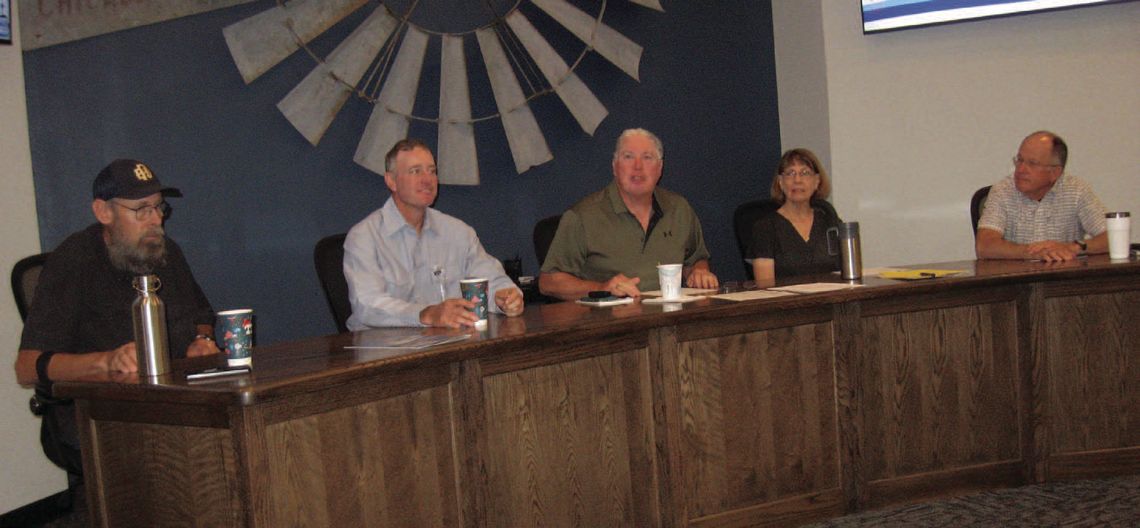
“We have received a good amount of rain,” District Groundwater Field Technician Schrader Davis told directors during the May 28 meeting at their new headquarters in Burnet at 303 Bluebonnet Drive, one block south of the Storm’s restaurant.
Through the end of May, he measured a total of 21 inches of rain in Naruna and 12 inches in Spicewood, Davis added.
In turn, the directors voted unanimously to lower restrictions from Stage 3 (severe drought conditions) to Stage 2 (moderate drought conditions).
Stage 2 promotes voluntary reduction of groundwater use by 10%, according to dis- trict officials.
“I would like to see more rain before we go to Stage 1,” Pct. 1 Director Kathy Griffis-Bailey said.
Pct. 2 Board President Ryan Rowney, Pct. 4 Vice President Ricky Bindseil, Director-at-Large Paul King and Pct.3 Director Ceferino “Reno” Lamb agreed.
“We are moving into summertime, and things can dry up pretty quickly,” District General Manager Mitchell Sodek warned board members.
During his presentation, District Hydrology Consultant Dr. Neil Deeds advised the board to always remain diligent regarding how much groundwater in the district is available, especially from the Ellenburger, Granite Gravel, Granite Shoals, Hickory, Marble Falls and Trinity aquifers.
“Just because it rains – that is not recharge (to the aquifers),” Deeds said.
Often, the shape and size of local aquifers differ, and their level trends are not infallibly predictable, he added.
Normally, the district relies on the Palmer Hydrological Drought Index (PHDI) to measure moisture yield from local acquirers, the consultant said.
However, from time to time, PHDI data may lag behind real moisture conditions, Deeds added.
As an alternative to PHDI, Deeds suggested the board could create a “Burnet County water-level index.”
“Basically, it is a very simple normalization approach, where you subtract the average (aquifer) water level and divide that figure by the standard deviation,” Deeds said.
“There is a lot (of data) to wrap our arms around,” Rowney said.
During future weeks, the board may consider a “blend” between PHDI and the index Deeds suggested, Sodek told the Bulletin.
“Everything is on the table,” he added.
Also during the meeting, the board agreed to terminate a joint-funding agreement with the U.S. Geological Survey to monitor Delaware Springs water levels.
“We are entering a relationship with the Texas Water Development Board and their staff to come out (to Delaware Springs) at no cost,” Sodek said.
Turning to another matter, the board reviewed an application by Brandi Thomas to drill a second well on her 7-acre tract.
The directors opted to enforce Trinity Aquifer Management Zone rules enacted earlier this year, which limits tracts 10 acres or less to one well.
“There is no variance process,” Sodek said. “But there is nothing (in the rules) that prohibits her from pursuing other options.”
Other options could include rain water harvesting, well-sharing with neighbors or “trucking in” water from storage tanks, Sodek added.
Before the meeting ended, District Secretary Tracy Swanter reminded Bindseil and Rowney they are up for re-election in November. Both Bindseil and Rowney were elected without opposition in 2022.