After over a year of monitoring south of the border, a case of the New World screwworm (NWS) was reported in Gillespie County. The county is adjacent to Llano County and about 40 miles from the Burnet County line.
The reported case was found on a goat in the western part of Gillespie County.
On Wednesday, June 3, the first NWS case in the U.S. was confirmed in La Pryor, Zavala County in Texas.
As of Tuesday at 9 a.m., four total cases in Texas and one in New Mexico have been con- firmed. The New Mexico case was found on a dog, while the other Texas cases were found on cattle.
“This is an ongoing case. We took the sample over there at 9 a.m. yesterday (June 8) morning, the sample was con- firmed by 12 [p.m.]," said Brad Roeder, the Gillespie County AgriLife Extension Agriculture and Natural Resources agent. “The samples got sent to Iowa last night, and they are still, quote unquote, not 100% sure it’s screwworm.
“So there is a small chance that it may come back as a negative,” he added. “But we have to act like it is going forward because we’re getting information by the minute.
“And we think USDA and Texas Animal Health Commission are gonna keep going forward as it is an active case.”
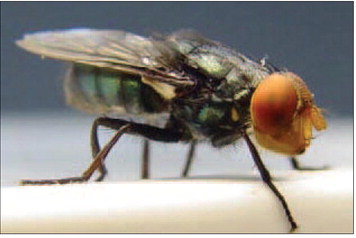
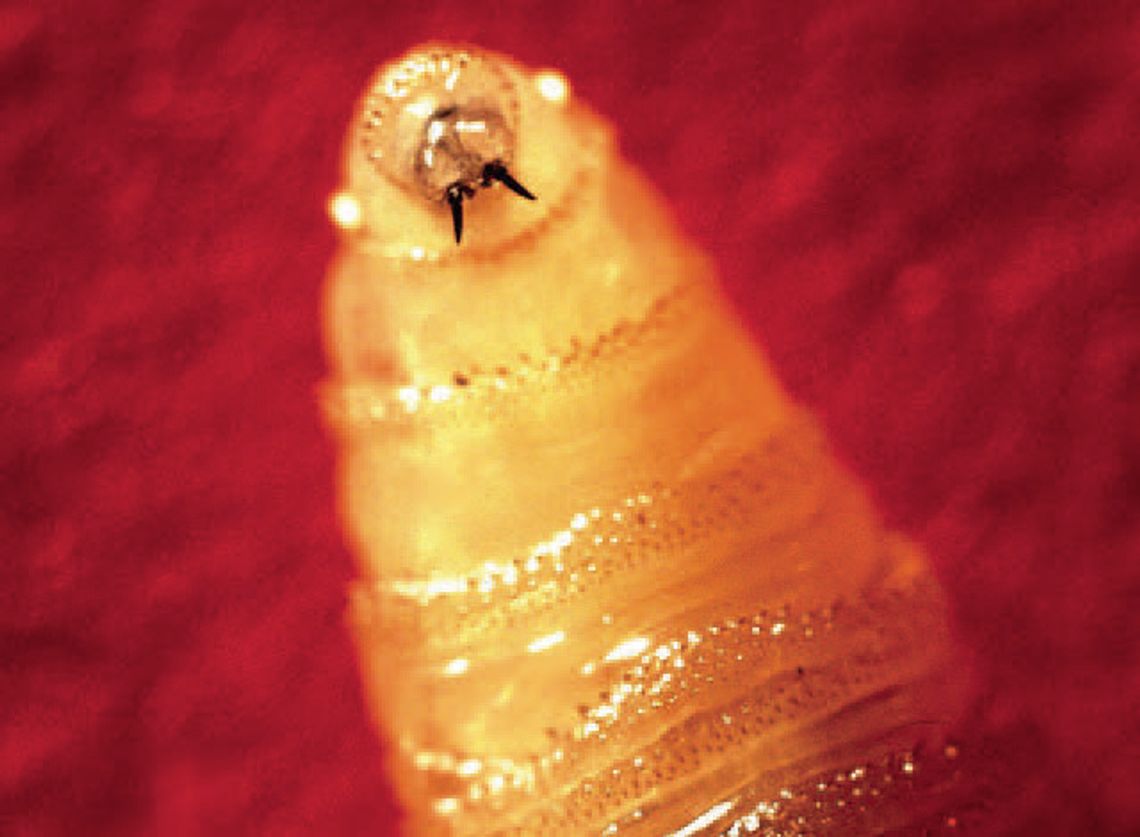
According to the National Library of Medicine, the New World screwworm (Cochliomyia hominivorax) is a “par- asitic fly whose larvae in vade and consume living tissue, causing myiasis (type of infection) with severe consequences for human health, animal welfare, and agricultural productivity.”
The parasite was eradicated in the 1960s in the United States, but remained endemic in parts of South America and the Caribbean.
After the New World screwworm infiltrated the U.S. from Mexico in early June, national and state health officials halted the importation of livestock from Mexico.
At 3:30 p.m. on Tuesday, June 9, local agents confirmed the sample was positive.
“Yesterday, around noon, the USDA report- ed a confirmed goat case here in Gillespie County. State agencies are currently gathering more information on that as we speak,” said Ashley Morris, the Fredericksburg/ Gillespie County Emergency Management Coordinator. “Detection and reporting is really critical in being able to stop the spread and being able to really get control of screwworm.”
While the case was reported by a local producer and a sample which is thought to be NWS is still awaiting final con - firmation from the US DA’s National Veterinary Services Laboratories in Ames, Iowa.
Morris added that the response is a state and federal led response.
“The agencies in charge of this response would be the USDA at the federal level, the Texas Animal Health Commission, at the state level, as well as [Texas A&M] AgriLife and the Texas Parks and Wildlife.
They’re all working together to respond to screwworms around the state,” she said. “Our county, in the event that we were to respond, would provide support through operations, with resources, and information to residents on how to identify screwworm and how to take the measures that need to be taken.”
Currently, the state and federal agencies are working on identifying reported cases.
“They are also working to restrict animal movements, to limit the spread of screwworm from county to county … They’re also conducting surveillance operations through traps and checks,” Morris said more identification labs are coming online in College Station and Uvalde, among other cities.
“I just really wanted to remind our folks, our residents, and our community that we really want y’all to be checking your animals daily. Check them for small and suspicious wounds.
Check body openings for larvae as well. And make sure that you report everything that could be of concern or suspicious,” Morris said.
The FGCEM will provide updates through press releases, social media and alert systems. A screwworm text and email list has been set up. Residents can text “screwworm” to 38276 to signup. For questions on the alert system list, reach out to [email protected].
Reporting can be done by calling the TAHC 24/7 line at 1-800-5508242. For suspicions of infected wildlife, citizens can report to the Texas Parks and Wildlife at 512-389-4505. Pets, especially outdoor pets can be susceptible to NWS. In the case of pet infection, owners can contact local veterinarians for reporting, testing and treatment.
The NWS is not a food safety concern. According to Morris, there is no threat to the parasite causing “improper or unhealthy meat.”
The Emergency Coordinator added that they will be working with agencies on potential economic recovery programs for impacted landowners.
“A lot of producers are worried about being in a quarantine zone. Realistically, it’s not a quarantine zone. It’s a restricted movement zone,” Roeder said. “We hope to get some more information on what that looks like, but you’re just gonna have to have somebody come and inspect your animals, pour some insecticide on that will kill any larvae or any worms that are in them. And then those animals can be moved out.”
Roeder said that there is talk that the restrictions will be a 72-hour restriction window, although no guidance has been made yet. However, the agent said animals will not be “locked down on your farm for a couple months.”
Collection kits will be available for producers for reported cases of NWS at the Extension Office, 38 Business Ct.,
Fredericksburg.
Roeder said auction sales in the county will not stop. Auction workers will be on alert for screwworms on livestock.
The Gillespie County Farm Bureau will host a multi-county seminar on NWS on Wednesday, June 17 at 6 p.m. at the bureau building, 237 Equestrian Dr., Fredericksburg. CEUs will be provided.
For more information on monitoring and de- tection, visit the official websites below: USDA Screwworm Information Website: screwworm.gov.
Annie Bresee is a reporter for the Fredericksburg Standard-Radio Post.